 English
 Français
Disposable Sterile Surgical Film

Your trusted medical supplies manufacturer.
No. 10 Ousheng Avenue, Pingwang Town, Wujiang District, Suzhou City, Jiangsu Province, China
+86 133 5801 3454
jasonzhangcas@gmail.com
MAKE A REQUEST
Product Categories
- Jumbo Raw Material Roll
- Wig Tape
- Wound Dressing
- Medical Tape
- Electrode Pad
- Postoperative Nutrition
- Postoperative Excretion
- Rehabilitation Braces
- First Aid Kit
- Medical Cotton Products
- Medical Gauze
- Bandages
- Patient Transfer
- Hospital Furniture
- Labour Safety
- Daily Homecare
- Medical Diagnose
- Hot&Cold Therapy
-
Body Patch
- Double Eyelid Sticker
- Eyelash Extension Patch
- Amblyopia Patch
- Acne Pimple Patch
- Facial Tape
- Wrinkle Tape
- Nasal Strip
- Mouth Tape
- Waterproof Ear Sticker
- Neck Wrinkle Patch
- Breast Care
- Underarm Pad
- I.V. Dressing
- Catheter Fixation Patch
- Scar Tape
- Wound Closure
- Waterproof Swimming Patch
- Thigh Patch
- Foot Care
- Clothes Sticker
Disposable Sterile Surgical Film Manufacturers
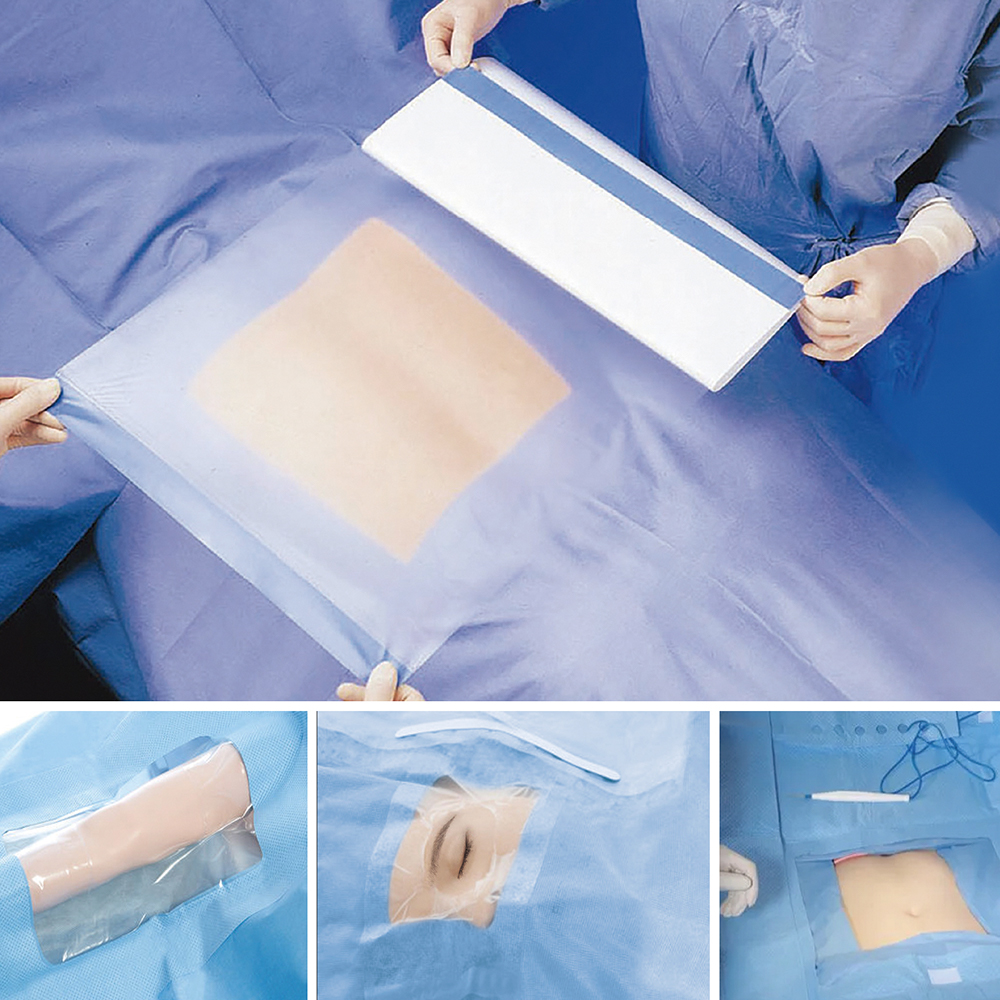
Disposable Sterile Surgical Film consist of a film, an adhesive layer, and a release liner. The film is made of low-pressure polyethylene or polyurethane film, the adhesive is medical-grade pressure-sensitive adhesive, and the release liner is anti-stick paper. They are suitable for application to the skin during surgical incisions to prevent surgical infection and are applicable to various surgical procedures.
Our Advantages
-
 1. Rich experienceWe are the professional manufacturer of medical equipment with more than 20 years experience, major in Disposable Sterile Surgical Film and other products.
 -
 2. Ample production capacityCurrently, we have 3 factories, capable of meeting both large and small customer orders.
 -
 3. Diverse product rangeWe have more than 200 kinds of SKU medical equipments.
 -
 4. Global market reachWe have exported our Disposable Sterile Surgical Film products to over 60 countries worldwide, including key markets in Europe, Southeast Asia, Africa and Oceania.
 -
 5. High-quality client resourcesOur markets include more than 100 hospitals, first-aid suppliers, supermarkets and retail sports shops. We have cooperated with well-known domestic and international businesses for many years.
 -
 6. Strong customization capabilityMore than 10 professional technicians, provide perfect ODM services.
 -
 7.Complete team supportProfessional R&D team, quality inspection team, sales team, and comprehensive after-sales service.
 -
 8. Flexible order termsLower MOQ, flexible ODM&OEM process.
 -
 9. Efficient customer serviceRapidly response rate and can quickly and promptly resolve customer issues.
 -
 10. Integrated supply chainComplete Supply Chain: From materials to finished Disposable Sterile Surgical Film products, everything is handled in our factory, not only ensuring quality, but more importantly, the new designs will not be leaked.
 -
 11. On-time deliveryDelivery is punctual, and we can deliver on time even during peak seasons.
Company
Suzhou Advan Medical Technology Co., Ltd.
ADVAN Medical (Suzhou Advan Medical Technology CO., LTD) is leading China Disposable Sterile Surgical Film manufacturers and OEM/ODM Disposable Sterile Surgical Film factory, the pioneering enterprise of ADVAN Group, has been a global leader in Medical industry, specializing in high-quality medical equipment and consumables since its establishment in 2003.
With 20+ years of experience in medical manufacturer and exporter, we specialize in first-aid, wound dressing, sport bandages, family healthcare and medical supply(such as gauze, bandages, cotton, medical tape and non-woven products). We have exported our products to 60+ countries worldwide, including Southeast Asia, Africa, Middle-east, Eastern Europe, Russia, South America and Oceania. Our customers include hospitals, first-aid suppliers, medical distributors and retailer shops.
In 2010, we established our first-aid factory to meet the demands of our customers. In 2018, to accommodate our growing requirements, we established our factory of kinesiology tape, cohesive bandages and elastic adhesive bandages. ADVAN Medical boasts a professional quality control team comprising hundreds of personnel who rigorously adhere to inspection procedures to ensure our products meet ISO13485:2016 standards. Most of our products are CE certified, and our Suzhou factories comply with FDA requirements.
With 20+ years of professional knowledge, skills, and dedicated team, we are committed to ensuring easy and fruitful cooperation and communication. We strive to satisfy your product needs and establish long-term cooperative relationships.
News
-
Self-adhesive electrode pads are the silent workhorses behind every TENS, EMS, and muscle-stimulation session. They deliver the low-voltage pulses that relieve pain, relax tight muscles, and speed up recovery, but only when the pad stays sticky and conducts evenly. With each use, the conductive hydrogel picks up skin ...
READ MORE -
A foam dressing is a soft, cushioning wound cover made from medical-grade polyurethane foam. It is designed to absorb exudate, keep the wound bed moist, and protect the healing area from friction and contamination. Because of its versatility, healthcare professionals rely on foam dressings for a wide range of acute an...
READ MORE -
Managing a wound at home means more than just placing a clean pad over it. The way a dressing fits can determine how quickly the wound heals and whether complications appear. One of the most common problems is a dressing applied too tightly. When a bandage squeezes the wound or the surrounding limb, it can reduce bloo...
READ MORE
Disposable Sterile Surgical Film Industry knowledge
Suzhou Advan Medical Technology Co., Ltd. manufactures wholesale Disposable Sterile Surgical Film manufacturers supply for hospitals, surgical distributors and private-label wound care brands. The product family covers surgical incision film and sterile surgical film built from a PE or PU carrier film, a medical-grade pressure-sensitive adhesive and an anti-stick release liner.
ADVAN Medical has operated as a medical consumables manufacturer since 2003, exporting to more than 60 countries across Southeast Asia, Africa, the Middle East, Eastern Europe, Russia, South America and Oceania. Surgical film sits inside our wound dressing range, alongside Wound Dressing and Transparent Wound Dressing.
What Our Surgical Film Range Covers
Disposable sterile surgical film is applied to intact skin around an incision site to create a continuous barrier between the operative field and the patient's skin flora. The construction is deliberately simple: carrier film, adhesive layer and release liner. Performance is decided by how those three layers are specified and laminated.
We supply the category in roll and sheet formats, in sterile and non-sterile presentations, with or without an integrated incise channel or fenestration. The table below sets out the configuration variables we work with when a project is quoted.
| Configuration element | Options we produce | Typical application fit |
|---|---|---|
| Carrier film | Low-pressure polyethylene film; polyurethane film | PE for general surgical draping; PU where higher moisture vapour transmission and conformability are required |
| Adhesive | Medical-grade pressure-sensitive adhesive, coated at specified weight | Skin contact during surgery; adhesion must hold under drape tension and moisture |
| Release liner | Anti-stick release paper, split or single-piece | Determines handling in theatre; split liners speed aseptic application |
| Format | Roll, sheet, fenestrated sheet, incise film with channel | Rolls for high-volume theatre use; sheets for procedure-specific kits |
| Sterilisation presentation | Sterile, single-use, individually pouched | Direct operative field use; single-patient, single-use to avoid cross infection |
| Packaging | Pouch, peel-open pack, kit insertion, private label | Hospital bulk supply, distributor cartons, custom procedure trays |
Material Selection: PE Versus PU Film
Low-pressure polyethylene gives a stable, low-cost barrier with predictable adhesive anchorage. It suits high-volume general surgery where the film is applied to relatively flat, dry skin and where drape adhesion rather than stretch is the priority.
Polyurethane film is thinner, more conformable and transmits moisture vapour, which matters on longer procedures and on contoured anatomy. It costs more per square metre, so we normally recommend it where the clinical requirement justifies it rather than as a default.
- Adhesive weight — controls initial tack, peel strength and residue on removal.
- Film thickness — affects drape behaviour, tear resistance and transparency over the incision.
- Release liner grade — must release cleanly without curling the film during aseptic handling.
- Sterilisation compatibility — film, adhesive and pouch must be validated together as a sterile barrier system.
Where the Product Fits
Surgical incision film is used across general surgery, orthopaedics, obstetrics, cardiac and vascular procedures, and in outpatient or day-surgery settings. The same construction also serves as an I.V. securement film, a catheter fixation film and a waterproof protective film where a sterile skin barrier is required.
Because the film is single-use and patient-specific, the buying pattern is usually repeat volume rather than one-off. Distributors typically carry several sizes and two or three film grades; hospitals standardise on one or two SKUs per department. We build the range around that reality.
Related products in the same supply chain
- Sterile Wound Dressing for post-operative coverage.
- Chest Sealing Patch for thoracic and emergency use.
- Medical Tape for fixation alongside film products.
- Medical Adhesive and Release Paper for customers who convert in-house.
Manufacturing and Quality Control
Our Suzhou operations run coating, rewinding, cutting and packaging under ISO 13485:2016 quality management. Most of our products are CE certified, and our Suzhou factories comply with FDA requirements. A dedicated quality inspection team works to written inspection procedures at incoming material, in-process and final release stages.
For surgical film specifically, the checks that matter are adhesive coat weight, peel adhesion, liner release force, dimensional accuracy of the cut, pouch seal integrity and sterility assurance of the finished pack. Sample retention and traceability records are maintained so that a delivered batch can be traced back through its material lots.
OEM and ODM Support
We operate as an OEM and ODM supplier for this category. Customisation covers film grade, adhesive specification, film thickness, sheet or roll dimensions, fenestration geometry, liner type, pouch format, printed artwork and carton configuration. Private-label programmes are supported from artwork through to shipping carton.
Our standard first sample lead time is 3–7 business days, with 1–3 modification rounds depending on product type and development needs. Minimum order quantities start at 1,000–10,000 units per specification for medical consumables; Pantone colour customisation starts at 20,000 units, and custom printed packaging starts at 100,000 units per packaging style.
Information We Use to Configure Your Solution
A quotation that holds up in production depends on a small set of inputs. When these are clear, we can confirm film grade, adhesive, dimensions, packaging and price without a second round of questions.
| Input | Why we need it |
|---|---|
| Procedure and application site | Determines film grade, conformability and whether fenestration or an incise channel is required |
| Target dimensions and tolerance | Sets cutting tooling, roll width and sheet count per pack |
| Sterile or non-sterile | Defines pouch format, sterilisation route and release documentation |
| Adhesion and peel targets | Drives adhesive selection and coat weight |
| Packaging and artwork | Confirms pouch, label, carton and private-label requirements |
| Annual volume and delivery schedule | Sets production planning, MOQ tier and shipment frequency |
| Destination market and regulatory route | Determines which compliance documentation is prepared with the batch |
Documentation, Packaging and Delivery Scope
Shipments are accompanied by the documentation set agreed at order confirmation, which typically includes certificate of conformity, batch record reference and, where applicable, sterilisation release documentation. Packaging is specified to protect the sterile barrier through transit and storage, with carton labelling matched to the customer's distribution requirements.
We handle the full chain from raw material to finished, packed product inside our own factories, which keeps quality control and design confidentiality under one roof. Delivery is planned against the confirmed schedule, and lead times vary with cooperation mode and product complexity — turnkey programmes typically run 30–60 days, standard product with packaging 20–50 days.
Frequently Asked Questions
What is disposable sterile surgical film made of?
It is a three-layer construction: a carrier film of low-pressure polyethylene or polyurethane, a medical-grade pressure-sensitive adhesive, and an anti-stick release liner. The film forms the barrier, the adhesive secures it to skin, and the liner protects the adhesive until application.
Should I choose PE or PU film for my market?
PE film is the economical choice for general surgery on relatively flat, dry skin. PU film is thinner, more conformable and breathable, which suits longer procedures and contoured sites. We quote both so the choice can be made against the clinical requirement rather than the price alone.
Can you produce surgical film under our own brand?
Yes. We run OEM and ODM programmes covering film grade, adhesive, dimensions, fenestration, liner, pouch format, printed artwork and carton design. Custom printed packaging starts at 100,000 units per packaging style, and Pantone colour customisation starts at 20,000 units.
What quality standards apply to your surgical film?
Production follows ISO 13485:2016 quality management, most of our products are CE certified, and our Suzhou factories comply with FDA requirements. Inspection covers adhesive coat weight, peel adhesion, liner release, cut dimensions, pouch seal integrity and sterility assurance, with sample retention and traceability records maintained.
How long does sampling and production take?
First samples are typically ready in 3–7 business days, with 1–3 modification rounds depending on the product. Production lead time depends on the cooperation mode: turnkey programmes with mould and packaging generally run 30–60 days, and standard product with packaging 20–50 days.
What is the minimum order quantity?
MOQ for medical consumables starts at 1,000–10,000 units per specification. Customised packaging begins at 100,000 units per packaging style, and Pantone colour or pattern customisation at 200,000 units. We also support lower MOQs for OEM and ODM development work.
Leading wholesale Disposable Sterile Surgical Film manufacturers, including a full range of Wound Dressing, Hydrocolloid Medical Products.


Copyright © 2026 by Suzhou Advan Medical Technology Co., Ltd. All Rights Reserved. This website is intended for regions outside China. Approval No:20240008
